DAY 2 (9th June 2024) Garmisch-Partenkirchen (Linderhof Palace & Oberammergau)
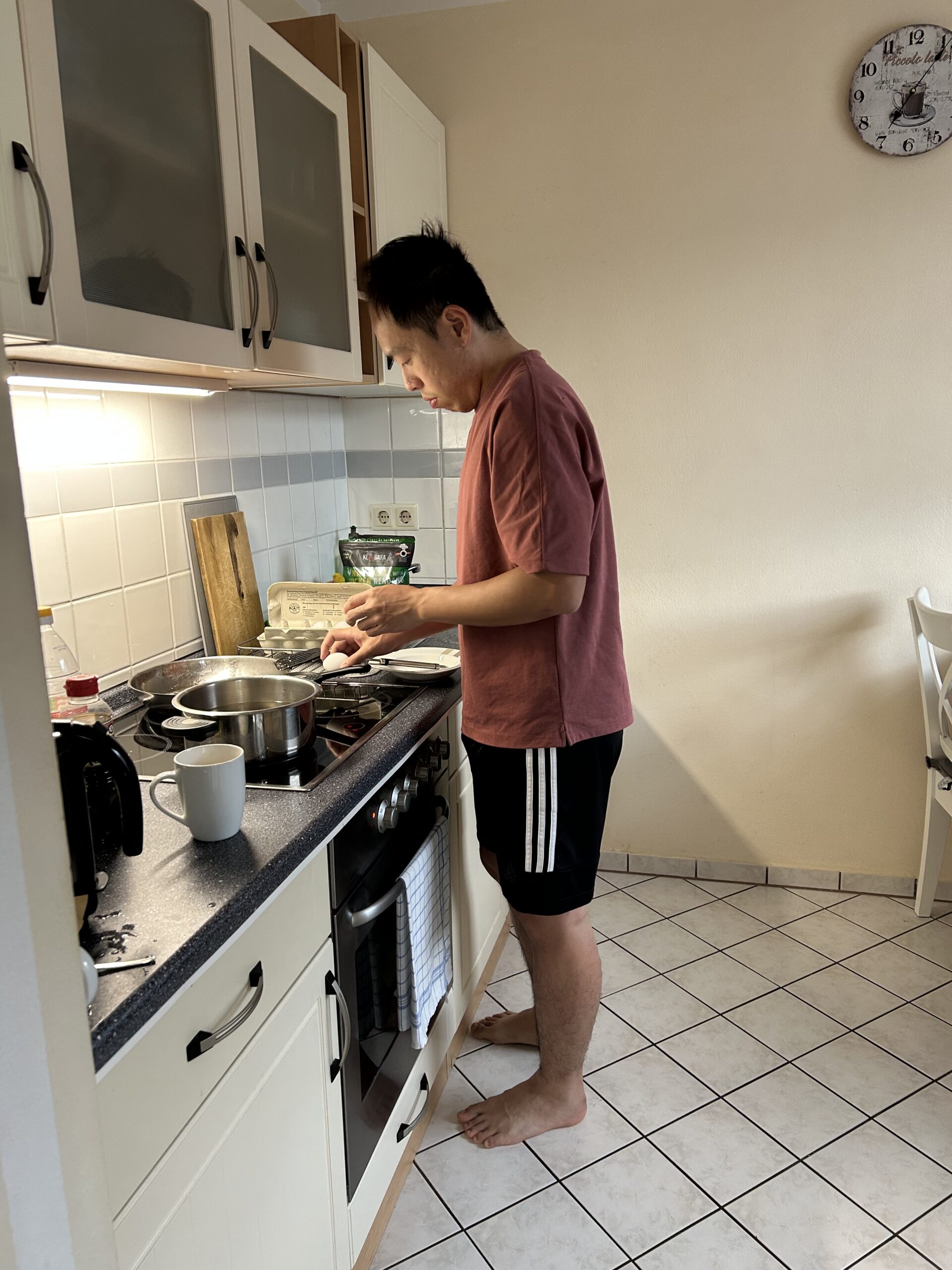
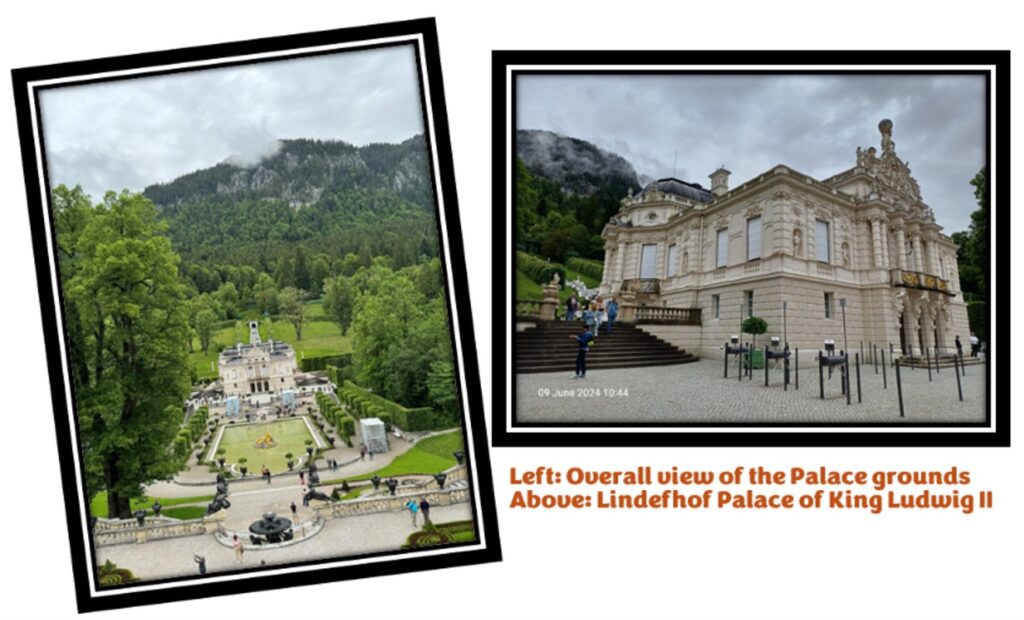
After a fantastic night’s sleep, we were up early to cook our own breakfast at the AirBnb house. We had a full day’s itinerary on this day, but we didn’t intend to rush either. Our first stop of the day, via Oberau, was to a small village named Ettal, specifically to the Linderhof Palace built by King Ludwig II, the smallest of the three palaces he built for himself.
YH preparing breakfast for us all
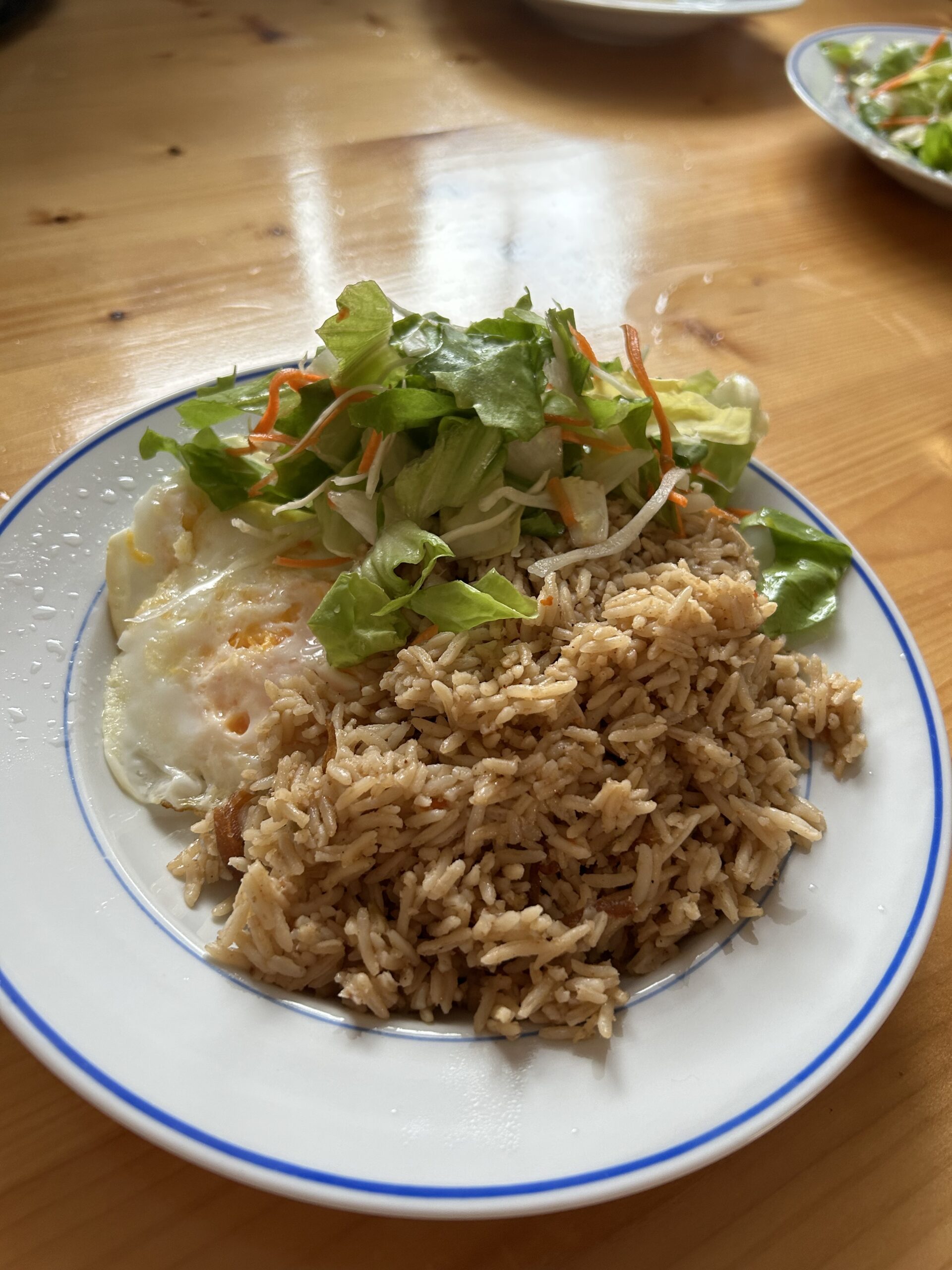
TYpical Asians, huh? Can't live without our rice
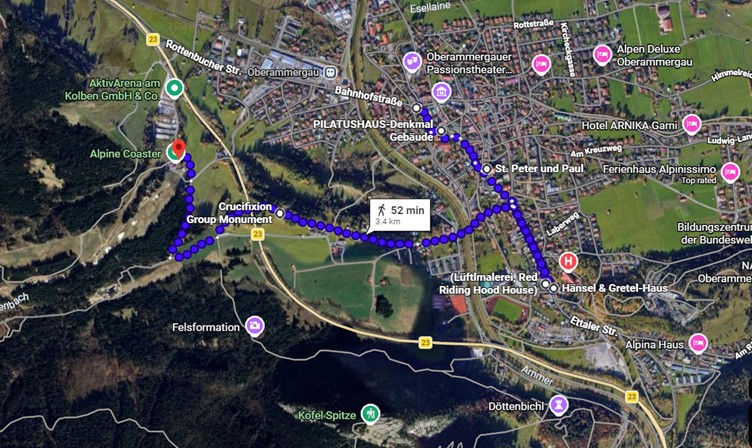
After that, we took a short ride into Oberammergau, another small village that has many minor attractions all over town. The buildings there were decorated with drawings of famous children’s stories like Hansel and Gretl, the Little Red Riding Hood and others. We climbed a small hill to visit the Crucifixion Monument and then ended the day riding the Alpine Coaster, before taking the train back to G-P. That was a heck of an adventure and excitement for the day.
Brief Stop at Oberau
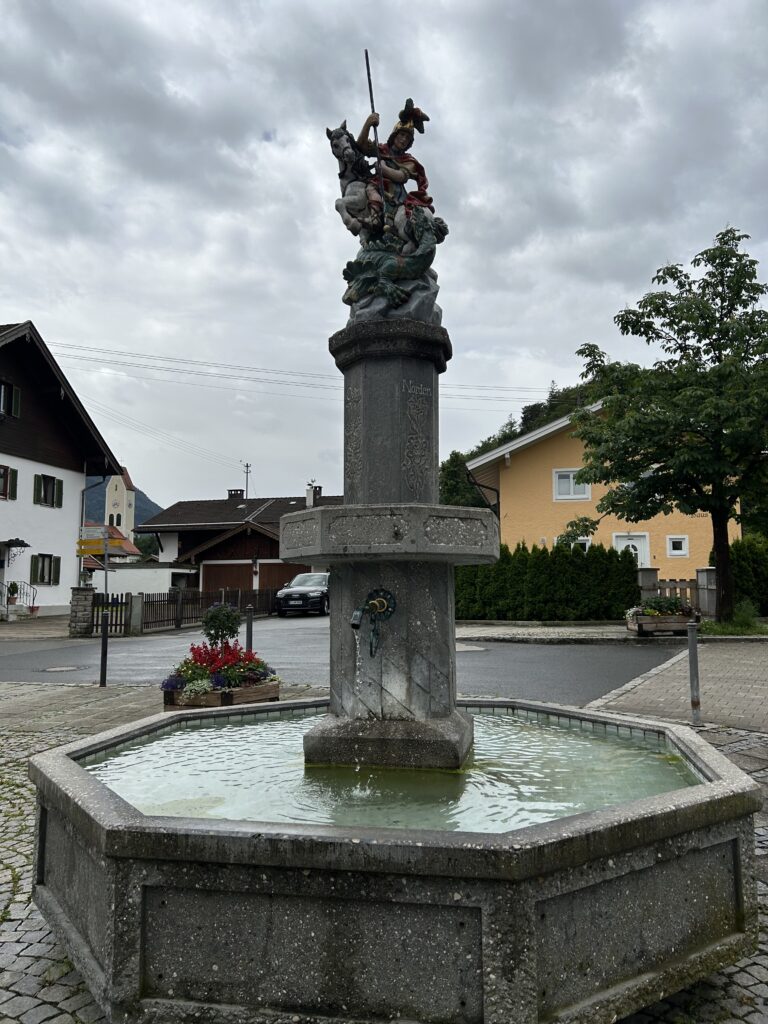
To get to Ettal, we took a local train to Oberau, a small village of just over 3,000 people. We had some time to walk around, before catching the bus to Linderhof Palace. There is a fountain known as the Dorfbrunnen Anno-Oberau, which is said to the centre of the village, and is the most well-known place in the village – a community focal point and a landmark.
Here I stand, right smack in the middle of the village
Linderhof Palace
We disembarked from the bus, roughly 300m away from the entrance to the Palace. We didn’t intend to, but we did spend more than 3 hours on the grounds of the Palace. Though touted to be the smallest of the three palaces built by King Ludwig II, the palace grounds is still huge. We went to almost every corner of the palace grounds, and it has many features and structures, designed and built for all the creature comforts a person can get.
Now We Know
The other two palaces built by King Ludwig II are the Neuschwanstein Castle near the village of Hohenschwangau, and Herrenchiemsee New Palace on an island in Lake Chiemsee. Neuschwanstein Castle was built between 1869 and 1886 atop a hill overlooking the village, and is the inspiration behind Disneyland’s Sleeping Beauty Castle. At 65m tall, it is the tallest castle in the world. Herrenchiemsee New Palace, meanwhile, was King Ludwig II’s deliberate replica of the Palace of Versailles, built on an island located on Lake Chiemsee near Munich between 1878 – 1886. However, neither of these two castles were completed during King Ludwig II’s lifetime. Hence, he spent most of his time at Linderhof Palace.
The first order of business was to visit the main palace building, which does not allow any photography, and we would have to follow a guide who explained the significance of each part of the palace. We get to catch a glimpse of how royalty of that era lived. There were many ornate items and decorations, paintings and sculptures all over the insides of the building, and they probably all had some sort of symbolic and political meanings to them – too many to remember!
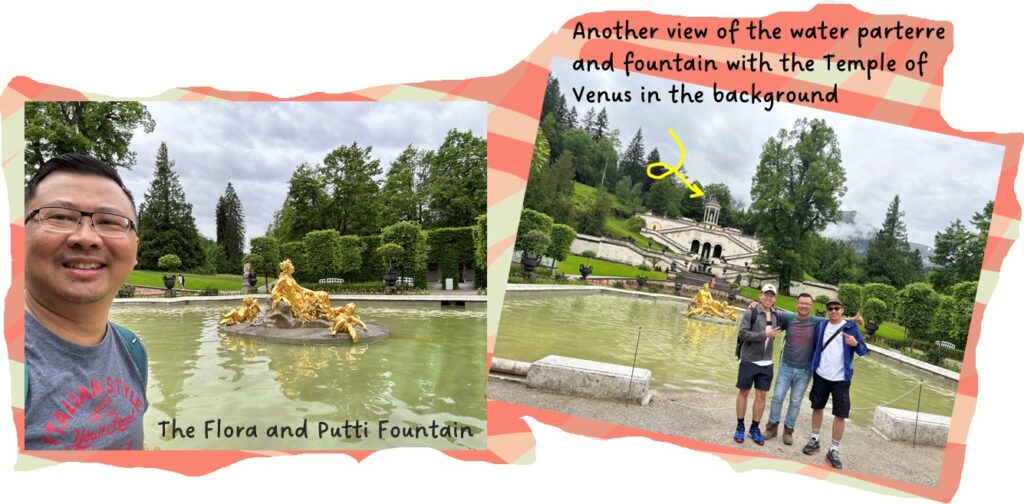
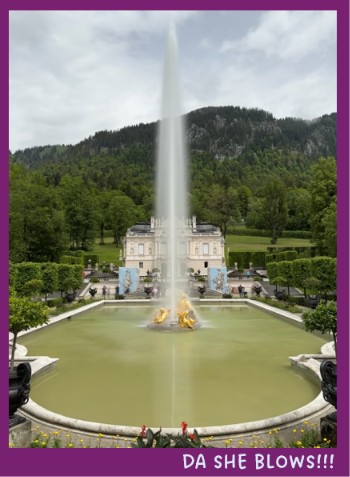
Probably the most interesting feature of the grounds is the big rectangular water parterre in front of the palace, containing the Flora and Putti Fountain in the middle. Flora, is the Roman goddess of flowers, gardens and the spring season while Putti are the winged human infants, and the entire sculpture is gold in colour. The fountain can shoot water 80 feet into the air using natural water pressure, occurring every 30 mins.
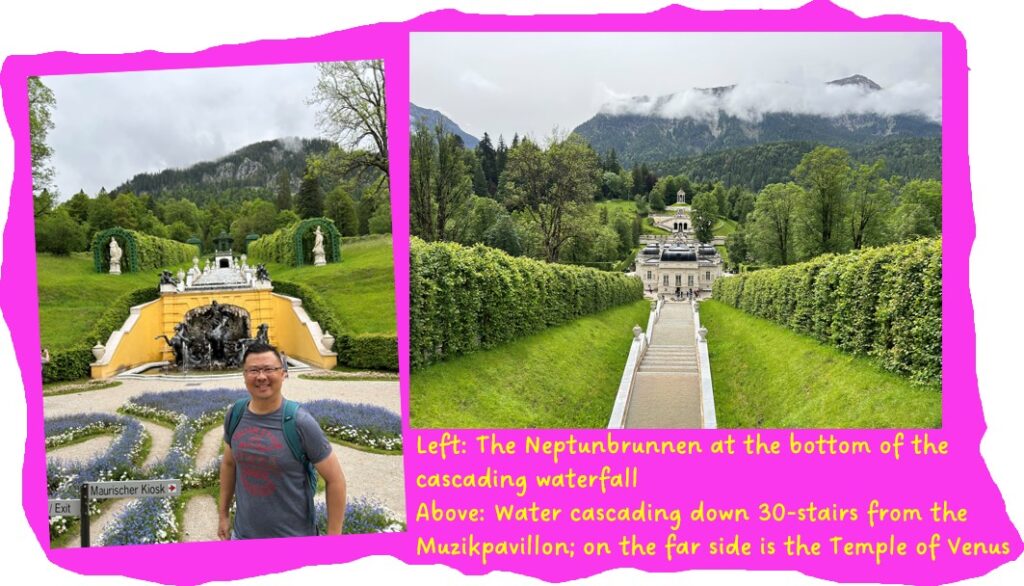
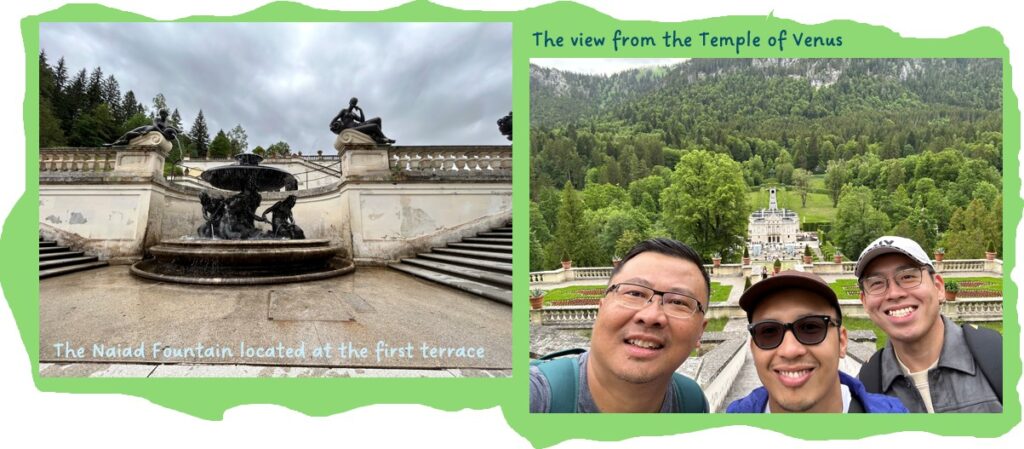
The entire northern side of the main palace building is dominated by a 30-step cascading water feature that starts at the Musikpavillon, a gazebo-like building at the very top of the hill and terminates at Neptunbrunnen, a cast-zinc statue of the Greek god of the sea, Neptune, driving three wild horses, symbolizing absolute rule. This is very much in line with the thoughts of King Ludwig II himself as a god-king of Bavaria.
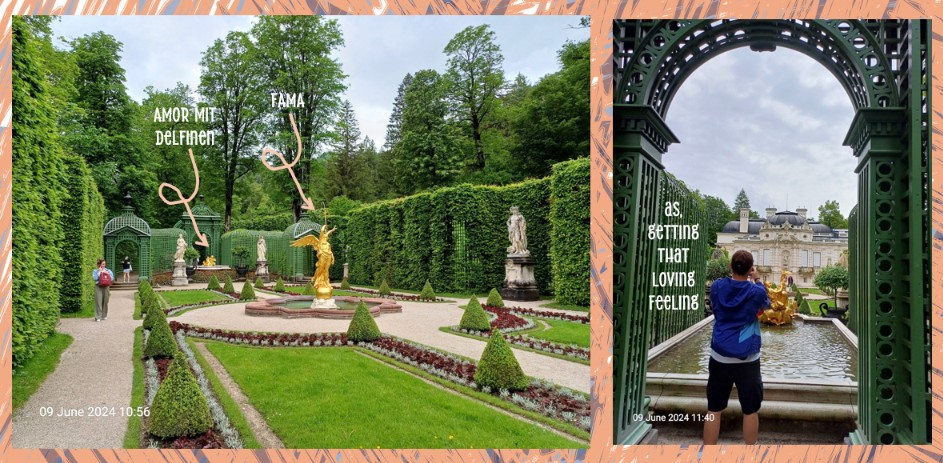
Once again, the symbolism is not lost, as the golden statue “Fama” is placed in the garden to signify King Ludwig II’s desire to embody the divine rights of kings over his subjects, and allowing “Fama” to project that fame and reputation as a god-king. Meanwhile, the statue “Amor”, also in gold, signifies romantic love, emotion and playfulness. The carefully placed sculptures are all part of the overall theme of the Palace.
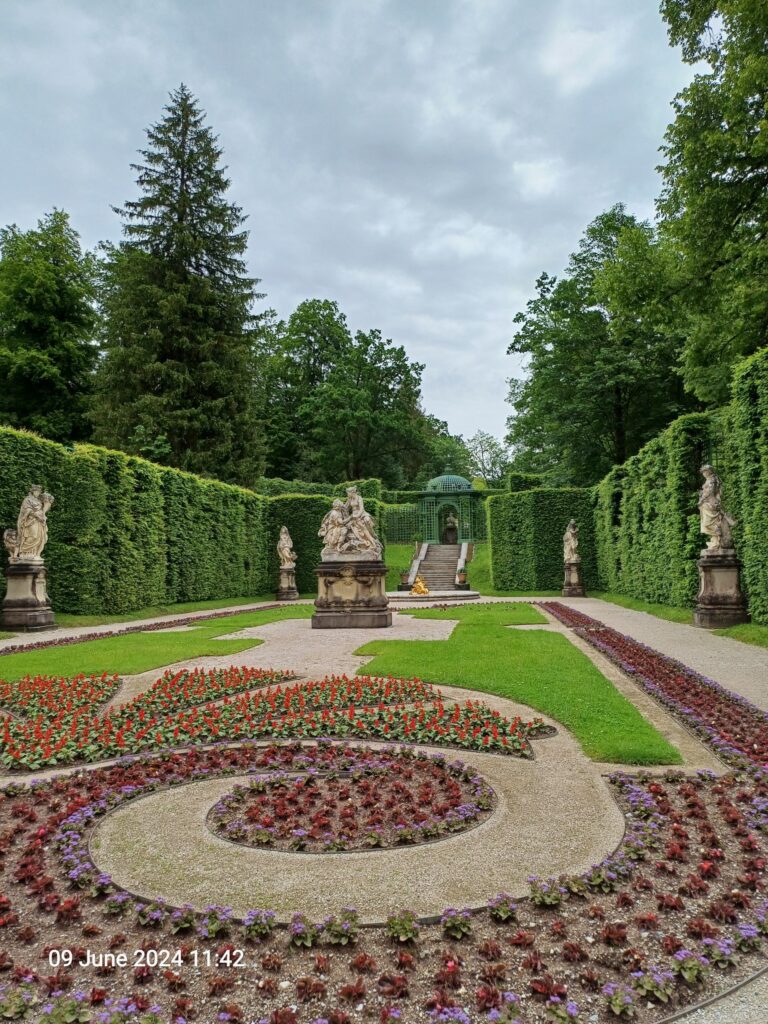
On the eastern parterre, the main features are the ornamental flower bed which have been well maintained even through the years, and the stone sculpture of Venus and Adonis, as well as the fountain with the gilt figure of “Amor Shooting an Arrow”. The stone sculpture is a depiction of Venus’ love (Venus is the goddess of love) and obsession with Adonis the human hunter and the tragedy that befell Adonis thereafter. King Ludwig II had always been enthralled by the magical world, and there are several other references to Venus throughout the Palace grounds. The god of romantic love Amor is again featured here, this time shooting an arrow of affection and desire.
The Eastern side of the Palace
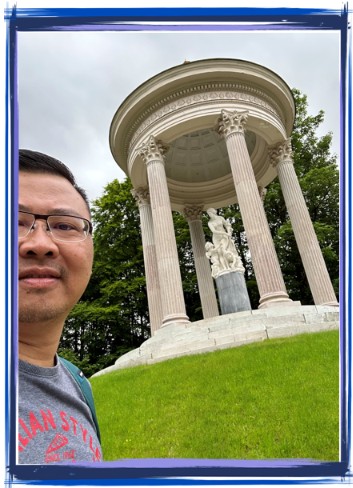
And finally, the entire southern side is dominated by the towering Temple of Venus, which sits atop a small knoll, corresponding to the opposite side which has the cascading water parterre. To get to the temple itself, one would have to traverse several flights of stairs to get from one terraced garden to another, until you reach the Temple. And at the very centre of the Temple stands a life-sized marble sculpture of Venus flanked by Putti.
This is the Temple of Venus, completed in 1877 took two years to build
Oberammergau
After the very long walk in and around the Palace, we thought that it was wise for us to move on to catch up with the rest of the itineraries scheduled. It was already past lunch time when we got off the bus at Oberammergau, a village of 5,300 people. The village may be small, but it is a hub for many activities and has many attractions to keep one busy throughout the day.
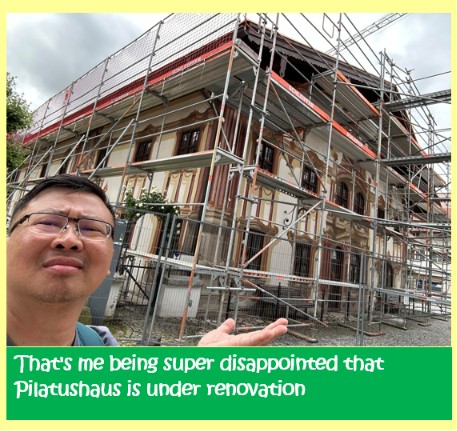
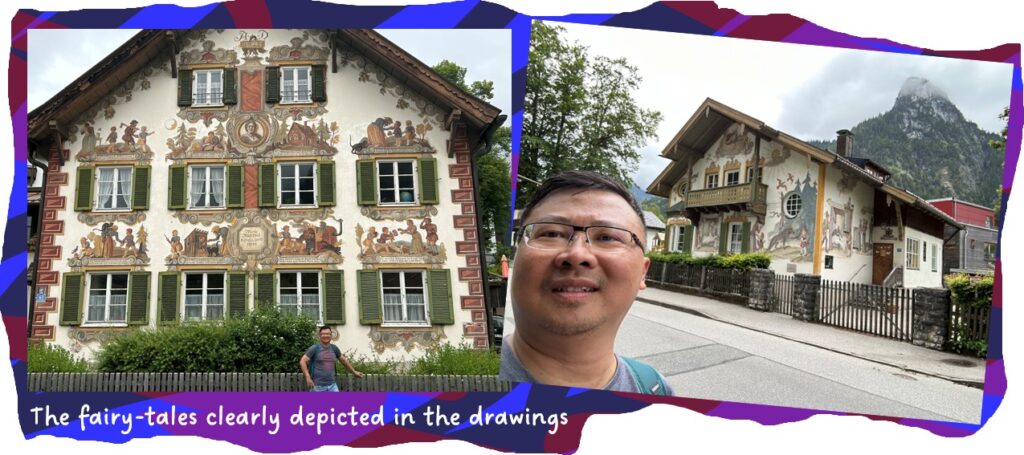
We were dropped off near the centre of town, and we made a beeline to Pilatushaus or Pilate’s House. It got its name from the paintings on the outer walls of the house depicting the condemnation of Jesus by Pontius Pilate, a scene from the Bible, painted by Franz Seraph Zwinck in 1784. The house was supposed to be demolished to make way for a parking lot in 1981! Thankfully the efforts of some of the locals to preserve the building bore fruit and it stands here today as it had been for centuries. However, renovation works were ongoing when we arrived.
Everywhere you walk, there are houses with all kinds of paintings depicting scenes from the Bible or fairy tales, or just local drawings with their own stories. Some are even self-portraits or portraits of family members etched forever onto the walls of the houses about the town. These painted houses actually have a name – the Luftmarelei, the tradition dating back to the time when Pilatushaus was first painted. Apparently, there are more than 300 such houses in and around Oberammergau.
Only because these two houses have depictions of well-known children’s stories, i.e. Hansel and Gretl and Little Red Riding Hood, we went specifically to them. They are located just several houses apart along Ettalerstrasse.
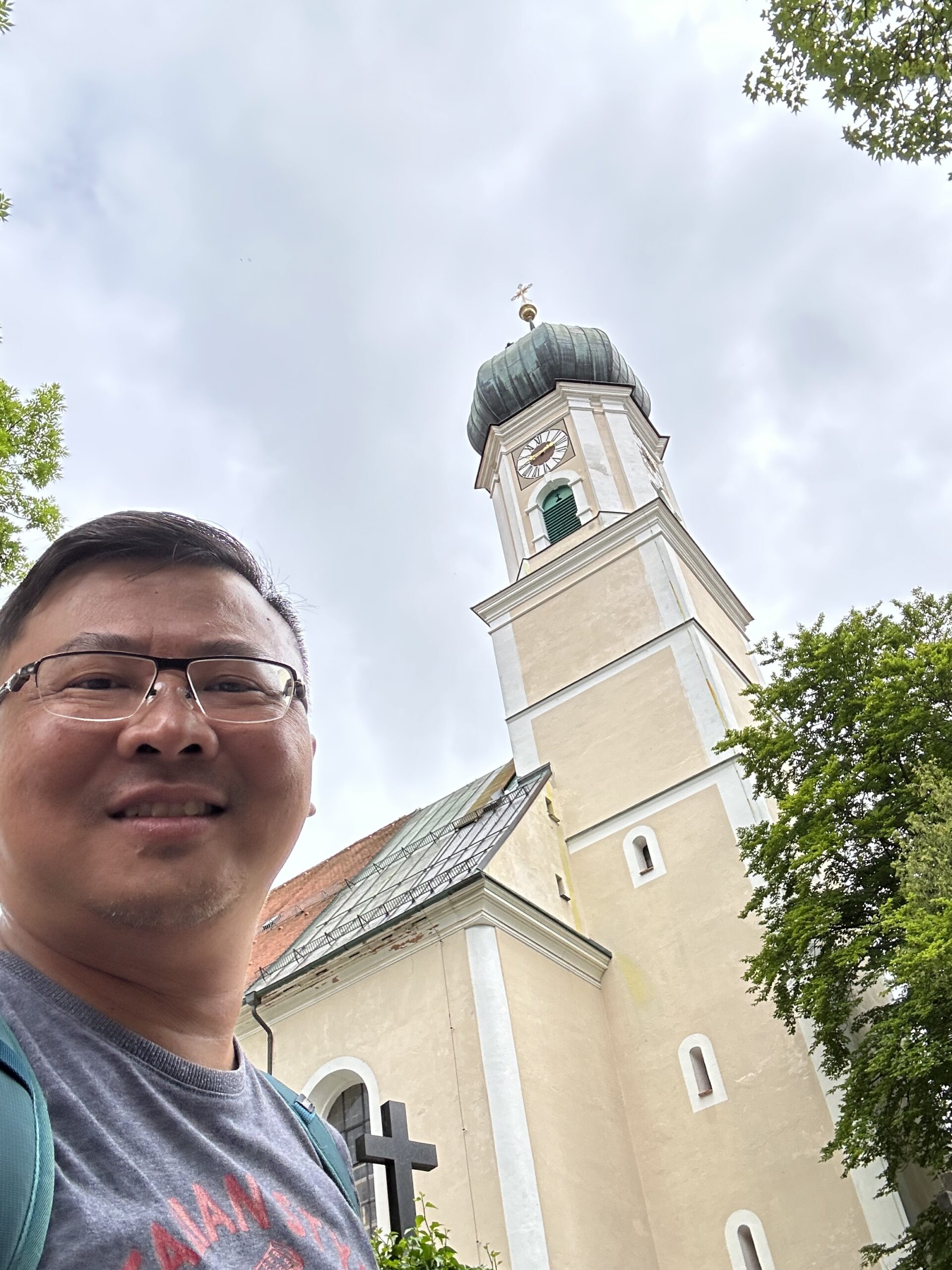
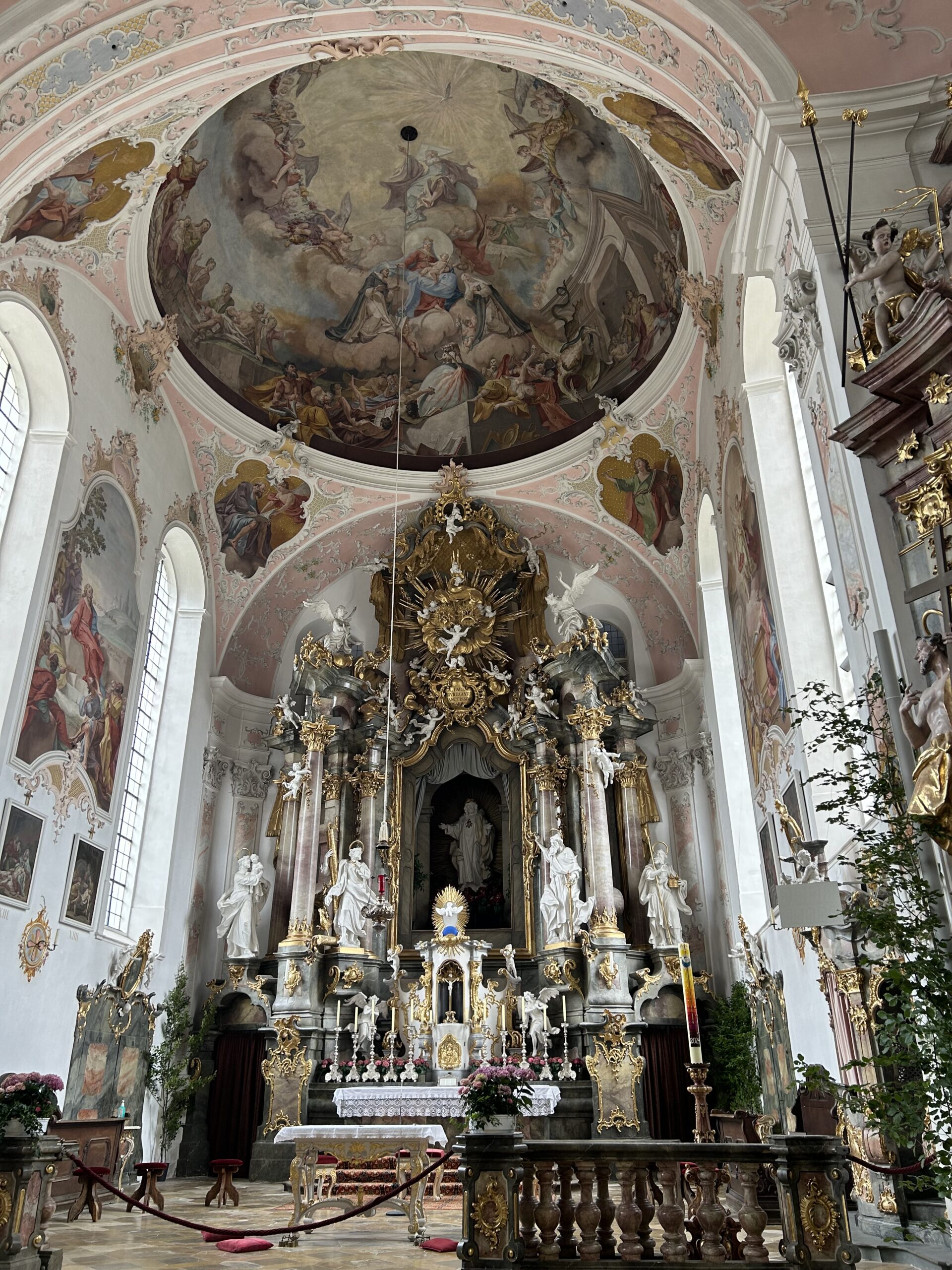
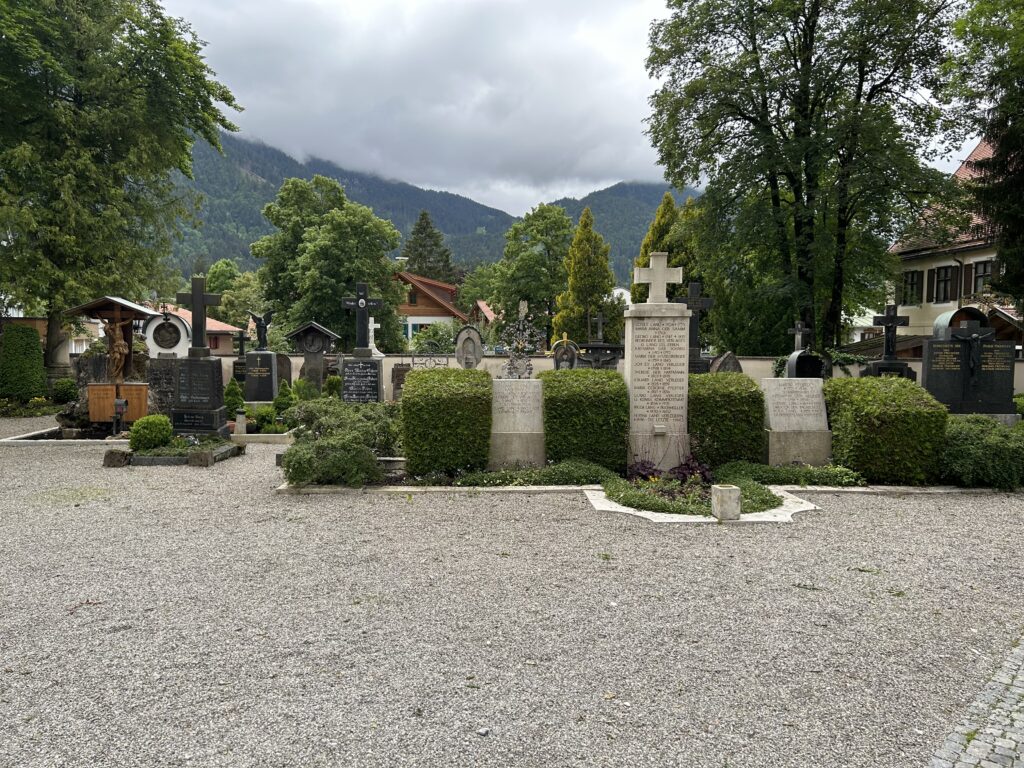
We dropped by the St. Peter and Paul’s Church in the village, an old church building constructed between 1735 and 1749. However, the site used to stand an even older church building, possibly even from the 9th century. The overwhelming feel as we walked in was the beauty of the murals drawn onto the shallow oval dome overhead. The altar area was also very impressive with the decorations and carvings of symbolic nature. Meanwhile, outside the church building is a small cemetery, very much a tradition of generations past, i.e. being buried next to the church building. Some of the tombstones date back several hundred years.
The exterior view of the church building
The murals on the dome and the decorations of the altar
A cemetery next to the church building, something from a bygone era
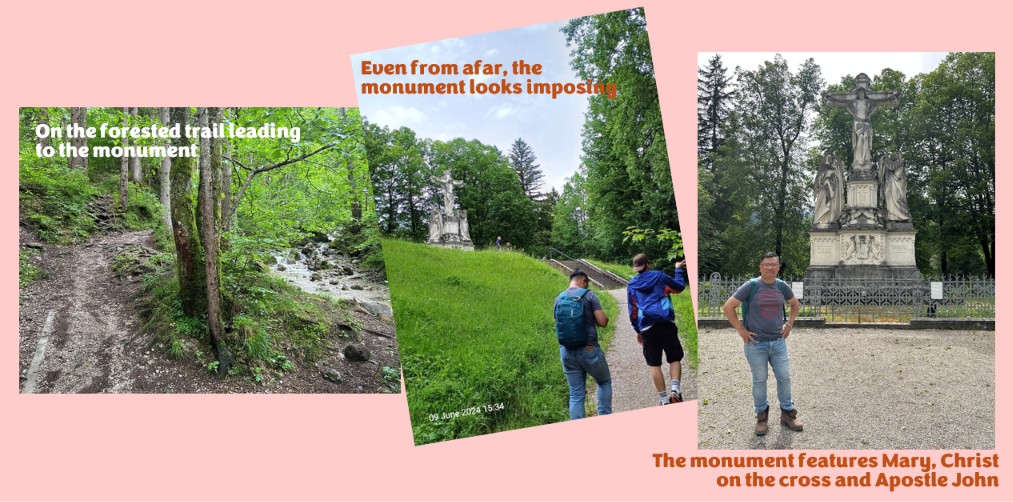
Up next, was a slightly longer walk up a forested dirt track to the Crucifixion Group Monument, a gift from King Ludwig II to the people of the village. He was so moved by the performance of the Passion Play (will describe more below), that he personally commissioned Professor Halbig, a renown sculptor from Munich to carve the monument in Kelheim marble. It took over two years to complete and subsequently was painstakingly transferred here, where it had been standing since 15th October 1875. King Ludwig II was said to come to this monument every year on 15th October to pray silently before the crowd that came here made it impossible for him to have silent time for himself.
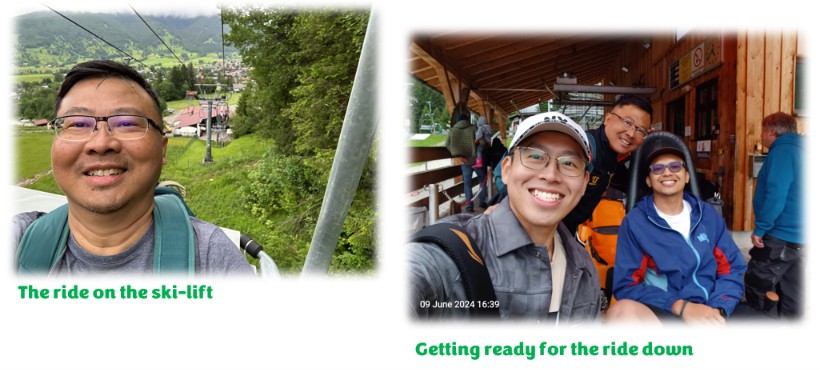
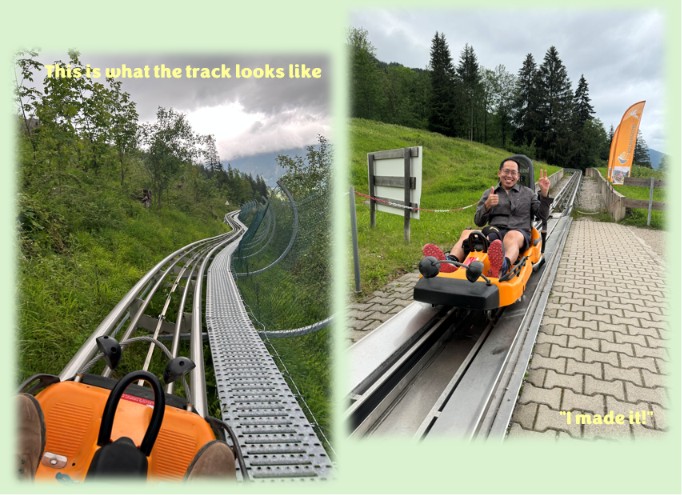
The last item on our itinerary was optional. It involved an even longer walk to the Kolben Alpine Coaster Park, where in wintertime, is more famous for its skiing. The people of the area installed the alpine coaster, which is a single person car on guided rails and gravity-driven with only the brakes acting as the speed control. Since it relies on gravity, the entire track is angled downwards in turns and spins, and it does pick up speed real quickly if one doesn’t apply the brakes frequently (Bro Ray: The first time I tried the alpine coaster was on Vinperl Island in Vietnam). AS and YH never tried, but you could tell they enjoyed it – a lot!
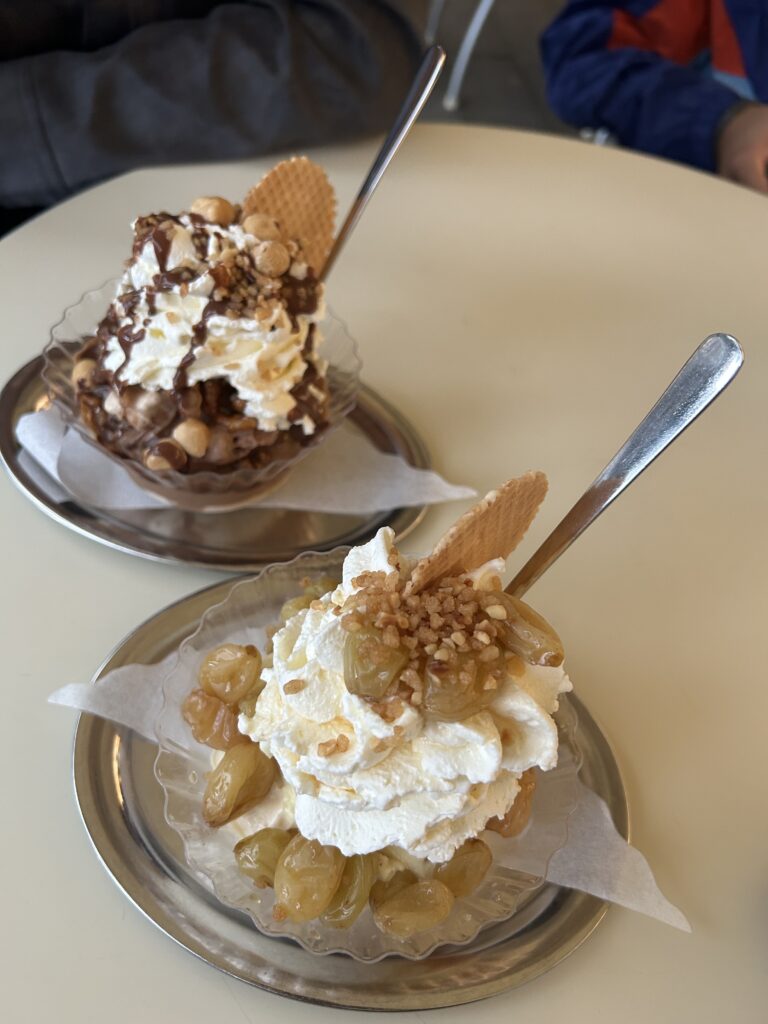
We rode the ski-lift to the top and then came down by the alpine coaster. The skies were threatening to open up, and so we hurriedly did the ride down. We did manage to reach the town centre right before the downpour. And had some ice-cream waffle at Eis Café Paradiso as our reward for the fulfilling day.
Just rewards for a job well done!
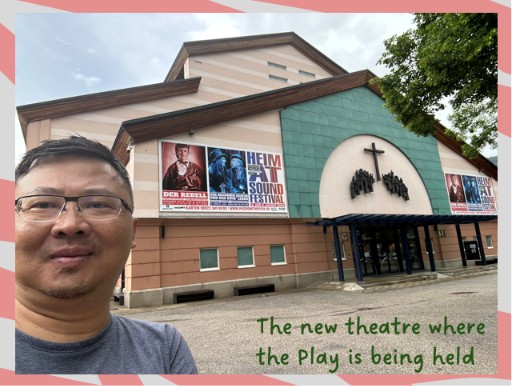
Finally, a little about the Passion Play. I did not know anything about this play before the trip, and it was really a chance encounter that we walked into the theatre that hosts the Play (this is the new theatre). Folklore has it that the remaining living residents of Oberammergau in the 1630s, which had been devastated by a bubonic plague, vowed to stage the Passion Play, which depicts the life, death and resurrection of Jesus Christ, every ten years if God would stop the plague.
The Play was staged in 1634 until 1674, before being changed to every decadal year since 1680. Every inhabitant of Oberammergau is expected to participate in one way or another, in acting, singing, stage management, props, etc. With several exceptions, this play has been going on and going strong since then. Famous people are said to have attend the Play, like US President Dwight Eisenhower (1950), Henry Ford (1930) and even Adolf Hitler. The next performance will be in 2030.
Summary of Day 2
To me, adventure travelling is the best teacher in life. I’ve learnt so much from just this day alone. The history behind the painted houses, or luftmarelei, and the reasons for staging the Passion Play and so much more. This day was certainly the busiest day for us, as we tried to squeeze in as much as we could from the places that we went to.
I would consider the Linderhof Palace as the standout location for me, but surprisingly not as many tourists. It is definitely not as famous as the other two castles, particularly Neuschwanstein Castle, but the symbolism in the architecture, sculptures and monuments should at least attract a whole lot more people. Meanwhile, the alpine coaster ride was the perfect icing on the cake.
DAY 3 (10th June 2024) Garmisch-Partenkirchen (Zugspitze, Eibsee & Grainau) Garmisch-Partenkirchen (G-P, for short) is the gateway to the German Alps. Technically, only a very
DAY 1 (8th June 2024) – Garmisch-Partenkirchen (Partnachklamm) We left Malaysia on 7th June 2024, and arrived in Munich, Germany before 7:00a.m. via Doha, Qatar.
DAY 7 (30th September 2023) – SEOUL (Demilitarized Zone) Although not many people would consider this a touristy place per se, as an adventure traveller,